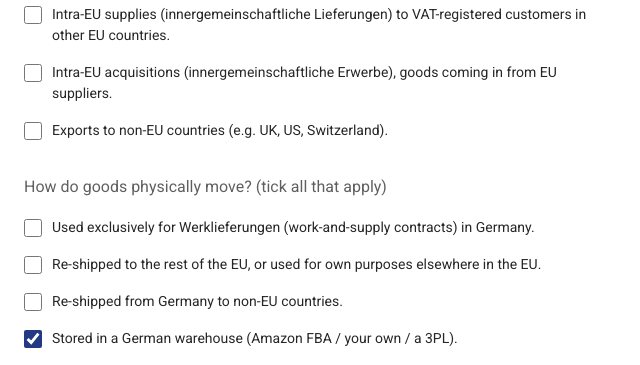
Why the German 3PL trigger catches Shopify sellers off guard
The German VAT obligation kicks in the moment goods are stored on German soil, regardless of where your company is based, where your Shopify store ships from most of the time, or how much you sell. This trips up three groups of Shopify sellers in particular:
- Shopify Fulfilment Network expansions. SFN has warehouse locations across Europe; adding a German SFN location for faster delivery creates a VAT obligation from day one of operation.
- Third-party logistics providers. German 3PLs advertise fast DE delivery to Shopify sellers, and the VAT trigger is easy to miss in the middle of a fulfilment onboarding: the moment your inventory arrives at their German warehouse, you need a German VAT number. Most providers ask for your USt-IdNr. eventually, often well after your first shipment. We work with byrd directly on German VAT guidance for their sellers.
- Hybrid Shopify + Amazon sellers. You list the same SKUs on Shopify and Amazon. Your Amazon FBA inventory is in Germany. Your Shopify orders may be fulfilled from that same FBA inventory (via Multi-Channel Fulfilment). Either way, German inventory means German VAT registration.
Practical check: ask your 3PL where your inventory physically sits. If any of it is in Germany, even temporarily, you need a German Tax ID. Retroactive registration after the fact is always more expensive than registration before the first shipment.
OSS vs local registration: the Shopify decision
OSS (One-Stop Shop) lets you file a single quarterly return covering B2C cross-border sales to all EU countries. It's a simplification regime: one return, one payment, one home-country tax office. Local registration means one tax office per EU country where you have obligations.
| Factor |
OSS |
Local German registration |
| Works for inventory in Germany? |
No, OSS doesn't cover local inventory sales |
Yes, standard path |
| Filing frequency |
Quarterly |
Monthly or quarterly, as the tax office decides |
| Number of returns per year |
4 (plus domestic returns) |
4 or 12, plus 1 annual |
| Language of filing |
Your home country's system |
German (to the Finanzamt) |
| Complexity |
Lower |
Higher (but a tax advisor handles it) |
| Good for enterprise B2B signaling? |
No DE USt-IdNr. visible |
Real DE-prefixed number |
The honest rule: if you have no German inventory and only cross-border B2C shipments into DE, OSS is simpler. If you have any German inventory (SFN, 3PL, FBA), you need local registration, OSS is not an option for those sales. Many sellers need both: OSS for cross-border and local DE registration for inventory-based sales. See our deeper OSS vs local VAT guide.
Does Shopify collect German VAT like Amazon does?
No. Shopify gives you the software for your own shop; it is not a marketplace, so German law never treats it as the deemed supplier (the platform taxed as if it had made the sale itself). You are the seller on every Shopify order, and once one of the triggers above applies, the registration, the returns and the payment to the Finanzamt are yours. Shopify's tax settings add VAT at checkout, but that money arrives in your account, not at the tax office.
Amazon, Etsy, eBay and TikTok Shop can work differently. On some sales (imported parcels worth up to €150, and goods already inside the EU sold by a seller established outside it) the marketplace charges and pays the German VAT itself. Stock held in Germany still needs your own German registration either way: the marketplace rule only changes who pays the VAT on the sales it covers.
How Shopify tax collection works with German VAT
Once you have your German Tax ID and USt-IdNr., setup in Shopify is straightforward:
- Shopify Admin → Settings → Taxes and duties.
- Under EU, add Germany with your German tax registration details.
- Shopify will then automatically apply the correct VAT rate to German customer orders: 19% standard, 7% reduced (books, certain food, select other categories).
- Decide whether prices show as VAT-inclusive or VAT-exclusive. In Germany B2C most stores show VAT-inclusive prices with "inkl. MwSt." disclosure.
For each filing, you export your Shopify orders (Orders → Export, the dates of the filing period, as a CSV file) and upload the file in your dashboard. We read every order, place it in the month it was delivered, and show you your German figures, with anything unusual set aside and named. You check them, and we file. How to export your Shopify orders.
Hybrid sellers: Shopify + Amazon on one VAT registration
Most serious e-commerce brands sell on multiple channels. German VAT handles this cleanly: one registration, one Tax ID, one VAT return (UStVA) covering all channels. You aggregate:
- Shopify orders shipped to Germany (net of returns)
- Amazon.de orders (where you are the seller of record, not marketplace-deemed supplier)
- eBay.de orders
- Direct B2B orders via invoice
- Any other sales channels
Important: where Amazon acts as the "deemed supplier" under §3 Abs. 3a UStG (mainly for non-EU sellers on certain SKUs), Amazon collects and remits the VAT itself, so those sales are excluded from your UStVA. Vaytax's dashboard separates marketplace-collected VAT from your own.
No fiscal representative, no per-channel fees
Two points on cost:
- Fiscal representation. Germany does not require a fiscal representative for standard VAT registration and filing; a licensed German tax advisor acting for you is enough. A separate fiscal-representation fee is not needed for standard German VAT compliance.
- Per-channel or per-transaction fees. Vaytax's €99/month is flat: your Shopify volume could grow 10x with no fee increase.
What this looks like for two Shopify sellers
Examples from our own clients, shared without names.
A US manufacturer of audio equipment sells through its Shopify store and keeps stock at a third-party warehouse (3PL) in Germany. That stock is the German 3PL trigger described above. Its registration goes to the tax office in Bonn (Finanzamt Bonn-Innenstadt), which handles companies from the United States, because the office follows the country the company is established in, not where the warehouse is.
A Slovenian company sells garden and outdoor goods through Shopify to consumers and businesses in Germany. It ships from its own stock in Slovenia, so nothing is stored in Germany, and it also sells into France. With no German warehouse, its question is the cross-border one from the scenarios above, not the warehouse trigger.
 Shopify, WooCommerce & own shops · Stock at a German warehouse